Building the Perfect Weekly Harvest for Your Restaurant
For a busy restaurant, having fresh microgreens available when you need them can make menu planning much easier. A weekly harvest program gives your kitchen a consistent supply while still allowing you to choose varieties that fit your dishes.
The key is to build a harvest around your menu, your volume, and the way your kitchen actually uses microgreens.
1. Start With Your Weekly Usage
Before choosing a subscription plan, think about how many trays your kitchen typically uses each week.
Consider:
- How many dishes use microgreens?
- How many portions do you serve?
- Are microgreens used as a garnish, an ingredient, or both?
- Which days are your busiest?
- How much product do you typically need for a week?
Understanding your usage gives you a better starting point for choosing the right weekly harvest.
2. Choose a Plan That Fits Your Kitchen
Root & Rack Farms offers three weekly harvest options designed around different kitchen needs:
Chef Starter — 2 Harvests Per Week
A practical option for cafés, bakeries, smaller kitchens, or restaurants that use microgreens in a limited number of dishes.
$76/week
Chef Standard — 4 Harvests Per Week
A balanced option for kitchens looking for a dependable weekly supply across several dishes.
$140/week
Executive Kitchen — 6 Harvests Per Week
Designed for higher-volume restaurants that use microgreens regularly across their menu.
$204/week
Choosing the right plan helps you maintain a consistent supply without ordering more than your kitchen can use.
3. Mix and Match Your Varieties
One of the biggest advantages of a weekly harvest is flexibility.
Rather than relying on just one variety, build a selection around your menu.
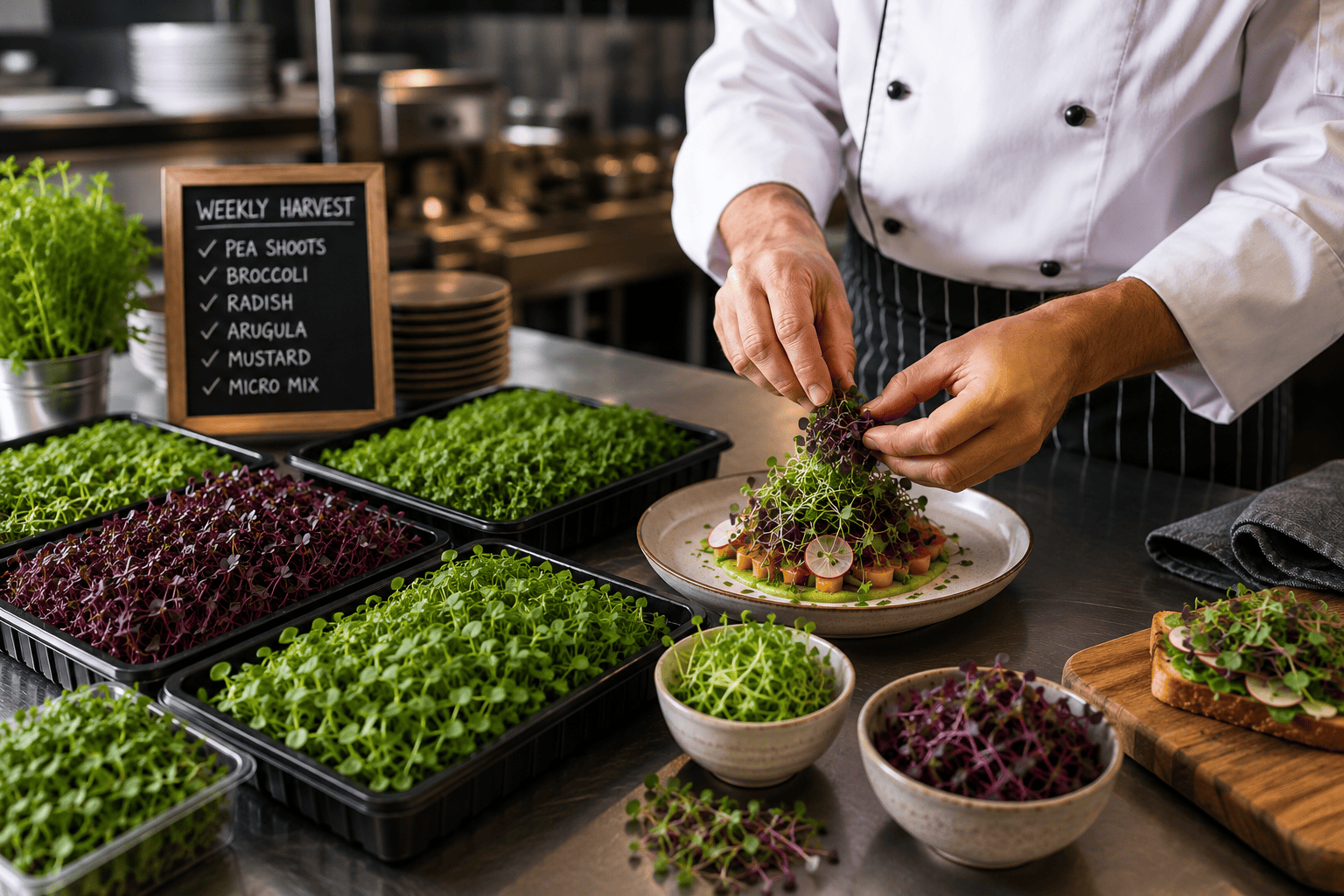
For example, a weekly harvest might include:
- Peas for fresh, mild flavor
- Broccoli for versatile everyday use
- Arugula for a peppery finish
- Purple Radish for color and character
This gives your kitchen several options to work with throughout the week.
4. Think About Your Menu
Your weekly selection should support the dishes you're actually serving.
If your menu includes fresh salads, bowls, sandwiches, and seafood, you may want several mild and versatile varieties.
For richer dishes, peppery varieties can provide contrast.
For fine-dining presentation, colorful varieties can add an eye-catching finishing touch.
Instead of choosing microgreens simply because they look good, ask:
“Where will we use this in our kitchen?”
That simple question can make your weekly selection much more useful.
5. Add Premium Varieties When You Need Them
Sometimes a standard variety is exactly what a dish needs. Other times, you may want something more distinctive.
Root & Rack Farms' Premium Selection includes slower-growing varieties such as Premium Leeks and Premium Cilantro.
Premium options can be a great choice for:
- Signature dishes
- Seasonal menus
- Special events
- Fine-dining presentations
- Dishes that need a distinctive finishing touch
Premium selections are available with a $6 upcharge.
6. Build Around Your Delivery Day
A consistent delivery schedule can help your kitchen plan ahead.
Root & Rack Farms currently offers Thursday delivery, with Tuesday planned as an additional delivery day later.
Planning your weekly harvest around your delivery schedule can help you coordinate prep, menu production, and inventory more efficiently.
7. Create a Harvest That Works Across Your Menu
The best weekly harvest isn't necessarily the largest one.
It's the one that gives your kitchen the right combination of flavor, color, variety, and quantity.
For example, a four-harvest kitchen might build a week around:
2 versatile greens + 1 colorful variety + 1 specialty selection
This gives chefs flexibility without making the selection unnecessarily complicated.
8. Adjust as Your Kitchen Grows
Your microgreen needs may change over time.
A new menu item, increased customer volume, seasonal dishes, or a new chef can all change how much your kitchen uses.
That's why a weekly harvest program should be flexible enough to grow with your operation.
Start with what your kitchen needs today, then adjust your plan as your usage changes.
Build Your Weekly Harvest With Root & Rack Farms
A good weekly harvest should make your kitchen's job easier—not harder.
Choose the plan that fits your volume, select varieties that complement your menu, and build a consistent supply around the way your kitchen works.
With Root & Rack Farms, your weekly harvest is designed around freshness, consistency, and flexibility.
Small-batch. Hand-harvested. Nutrient-dense. Powered by a tiny seed.
Ready to Build Your Weekly Harvest?
Explore our Weekly Harvest plans and find the option that fits your kitchen.